
Fuel security is a national priority. Site fuel resilience is what you control.
Diesel keeps mining, civil, construction and industrial sites running. When supply tightens or prices move, the sites that keep working are the ones that planned for it. This article covers what government has committed at national level, and what you can do on your own site.
Australia’s diesel exposure
Australia imports about 90% of its diesel. In calendar 2025, imports were around 30.2 billion litres against diesel sales of 33.5 billion litres, according to the Australian Petroleum Statistics (Department of Climate Change, Energy, the Environment and Water, September 2026 data extract).
That leaves mining, transport and agriculture exposed to global diesel supply and pricing. For your operation, delivery timing and cost can sit outside your control.
What government has committed
National fuel security is being addressed at government level. The May 2026 Federal Budget committed:
- $3.2 billion to establish the Australian Fuel Security Reserve, a government-owned reserve of around one billion litres of diesel and jet fuel.
- $7.5 billion for the Fuel and Fertiliser Security Facility, to secure more fuel from international partners.
- An additional 10 days of mandatory industry fuel stockholding for diesel, petrol and jet fuel by 2030, as set out in the Government’s joint media release of 18 August 2026.
Government says these measures together will lift Australia’s diesel and jet fuel reserves to 50 days. These are funding commitments, being delivered over time. Details are in the Budget Overview 2026-27.
These measures strengthen national fuel security. They don’t manage fuel at your pit, laydown or remote camp. That part is up to you.
What site fuel resilience looks like
Site fuel resilience is what you control: what you hold, how clearly you can see it, how much diesel you burn and how reliably your equipment runs. It has four parts.
Hybrid Power & Energy Systems
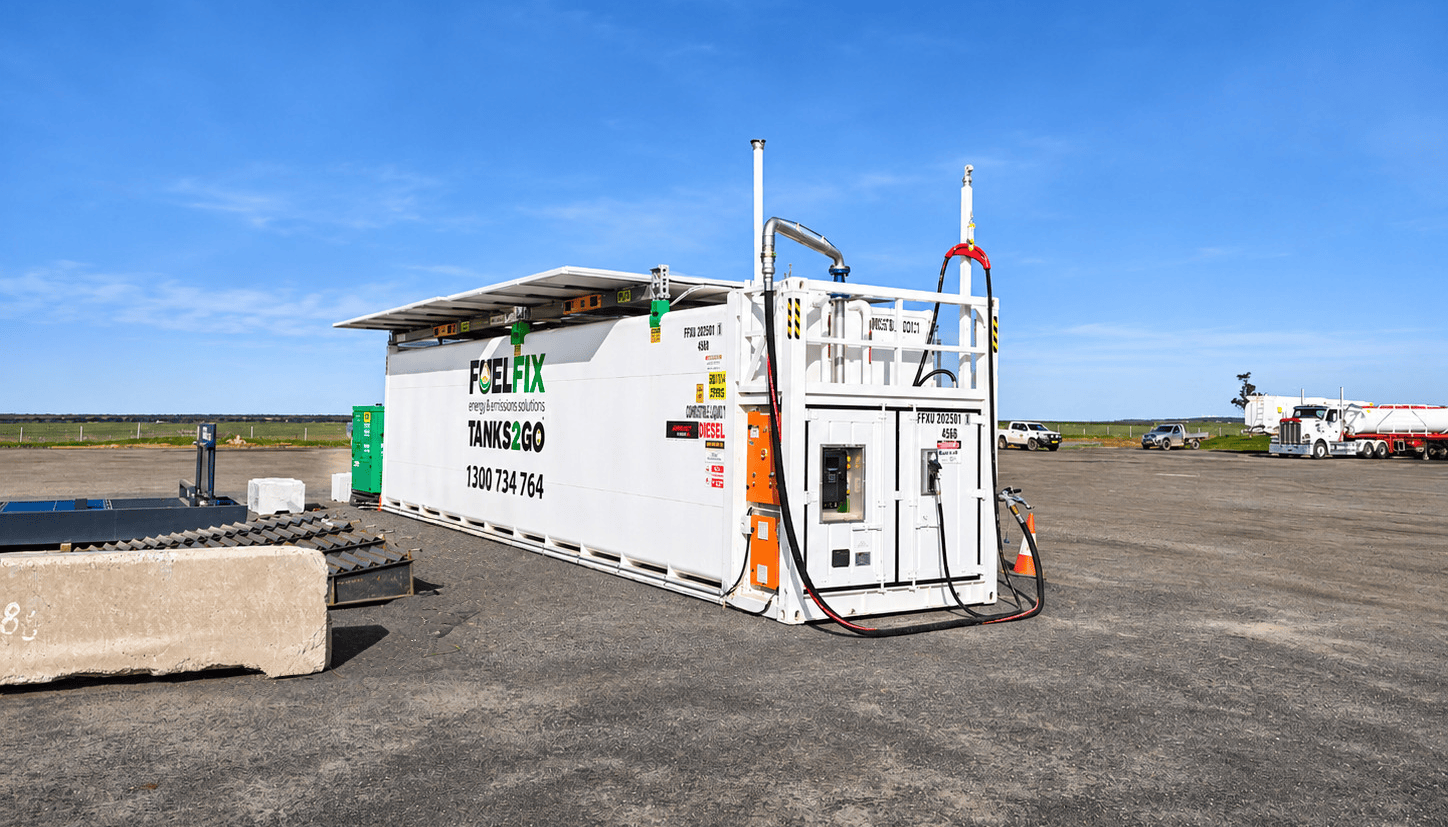
Hybrid and self-powered systems reduce and displace diesel burn on remote sites, so there is less exposure to supply and price swings. Every litre you don’t burn is a litre you don’t have to buy, store or haul.
Where they make commercial and operational sense, batteries and hybrid systems can reduce generator runtime, smooth peak loads and lower maintenance requirements. Fuelfix is energy agnostic. Diesel and hybrid sit side by side, and the right mix depends on your load profile, logistics and uptime requirements. See our hybrid power systems and battery energy storage.
Fuel Storage Infrastructure
Buffer capacity for remote fuel storage, sized to your operation, by hire or sale. That can mean fuel tanks and trailers or a full fuel farm designed to your site requirements.
Fuel Management & Monitoring
You can’t manage what you can’t see. A fuel management system shows what you hold, use and lose, so mining fuel management decisions rest on data, not estimates. Data analytics can then show where fuel efficiency can improve.
Service & Support
Preventative maintenance, rapid mobilisation and national support keep critical equipment reliable. Our repair and maintenance programs are built around uptime.
Fuel remains one of the largest operating costs on site, particularly for remote operations. Now, more than ever, the need to conserve fuel and optimise how it is used has become critical. (Practical Energy Transition for Remote Operations, 6 May 2026)
Proof on site
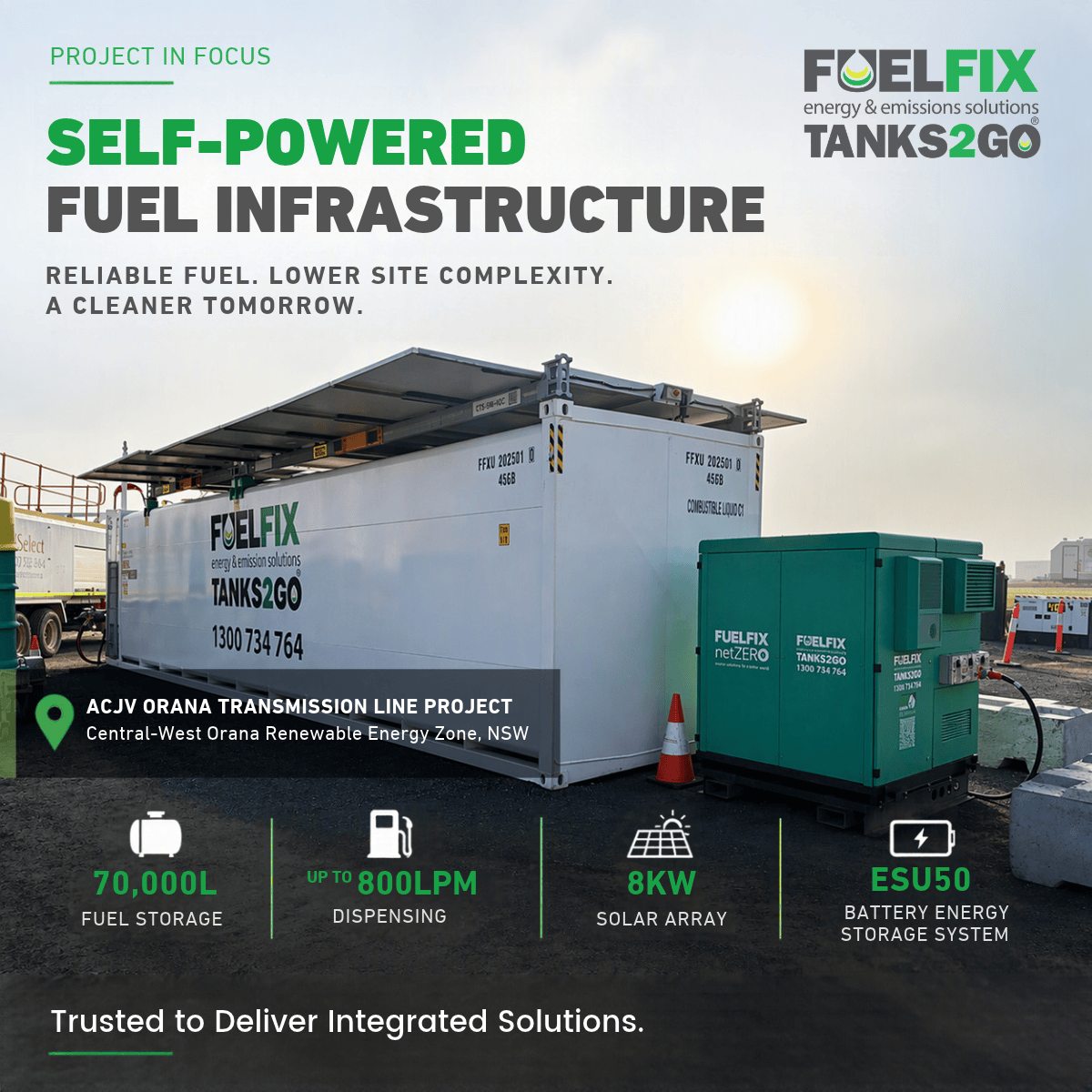
At ACJV’s Orana Transmission Line Project, Fuelfix delivered a self-powered fuel facility integrating solar generation, battery storage and generator backup. The system prioritises renewable energy and stored power, with the generator operating only when required while maintaining reliable power for refuelling operations. Compared with a conventional 40 kVA generator, the solution is estimated to save 20,800–26,000 litres of diesel annually.
Five questions to ask about your own site
- Is your fuel buffer sized to your real delivery times?
- Can you see what you hold, use and lose across every tank?
- Where is diesel being burned that a hybrid system could displace?
- When did your critical fuel equipment last have preventative maintenance?
- If you needed extra storage quickly, who could mobilise it?
For more on contingency planning, see Fuel Contingency Planning: How Australian Businesses Can Reduce Fuel Supply Risk.
Review your site’s fuel resilience
Our team can walk through what you hold, how you monitor it and where hybrid power could reduce your diesel burn.
See how we build fuel resilience on site →
Sources and dates: Australian Petroleum Statistics, DCCEEW, September 2026 data extract (diesel imports ÷ diesel sales, calendar 2025). Budget Overview 2026-27, May 2026. Joint ministerial media release, 18 August 2026. Figures checked 20 November 2026.